November 01, 2026
Cursor Tampered Update Tests Access, Audit, and Malicious Code Evidence
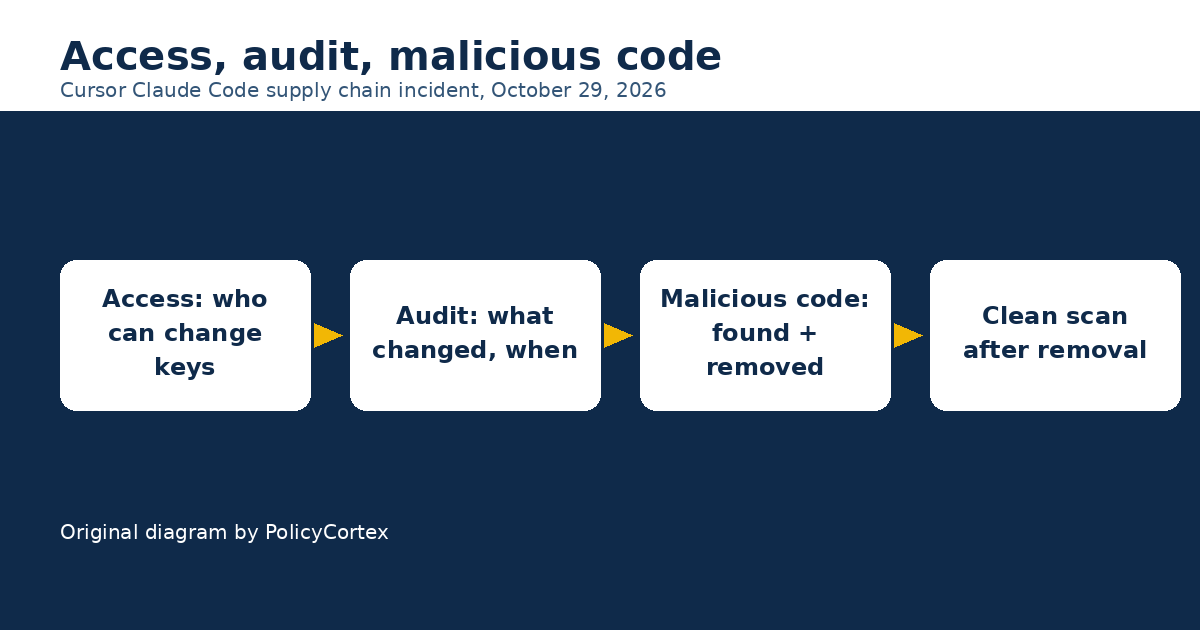
One incident can test three evidence families at once. This one does. On October 29, 2026, a tampered Claude Code update reached Cursor users. The update used the name Anthropic.claude-code. It appeared in the Cursor Visual Studio Code (VS Code) Extension Marketplace. Versions 2.1.312 and 2.1.313 for Windows and macOS were affected. The window ran from about 2:27am to 1:35pm Pacific Time.
What the tampered build did
The code added an attacker Secure Shell (SSH) key to authorized_keys. The key carried the label svc-telemetry. It set up persistence through a macOS LaunchAgent or a Windows scheduled task. It sent host details to an attacker server. On most hosts the reverse tunnel step failed without admin rights. The key, the persistence, and the host report still happened. Cursor later took the attacker server offline with its hosting provider.
Access control evidence
Access control asks who may change what on a host. The attacker key is a new access path. Evidence must show who may write to authorized_keys. It must show who may install or update extensions. It must show which accounts hold admin rights. On most hosts the tunnel step failed for lack of admin rights. That failure is evidence that least privilege held. Record it as a finding, not as luck. A host where the tunnel step worked needs a deeper review.
Audit evidence
Audit records must show what changed and when. The file needs extension install and update logs. It needs authorized_keys change records. It needs LaunchAgent and scheduled task creation records. It needs outbound connection logs for the exposure window. Each record needs a time and a host name. A gap in the window is a gap in the story. State the gap plainly when a log is missing. Do not fill it with a guess.
Malicious code evidence
Malicious code protection asks how bad code was found and removed. The file needs the detection source for this incident. It needs the key check result for each host. It needs the persistence check result for each host. It needs the removal record for each artifact found. It needs a clean scan after removal. A note that says "extension removed" proves nothing about the artifacts. The artifacts live outside the extension folder.
PolicyCortex does not clean developer hosts. PolicyCortex helps teams link proof to requirements.
Sources
- Cursor security notice, updated October 30, 2026. https://cursor.com/blog/claude-code-extension-security-notice
- The Hacker News article, October 2026. https://thehackernews.com/2026/10/official-claude-code-vs-code-extension.html
- OpenSourceMalware research findings, as quoted by The Hacker News.
- Original diagram by PolicyCortex.
Next step
Pull the install logs and key change records for the exposure window.