October 27, 2026
How Do I Document an Enduring Exception So It Scores as Implemented?
One requirement in your system may never fit the standard wording. A lasting, approved difference is called an enduring exception. Document it well, and an assessor can judge it on its merits. Document it poorly, and it reads like a gap you hid.
NIST means National Institute of Standards and Technology. CUI means Controlled Unclassified Information. NIST SP 800-171 Revision 2 sets the requirements for protecting CUI. NIST SP 800-171A gives assessors the methods to test each requirement: examine, interview, and test.
What counts as an enduring exception
An enduring exception is permanent, not temporary. A short delay while you fix a gap is not an exception. It belongs in your Plan of Action and Milestones instead. POA&M means Plan of Action and Milestones.
An exception also needs a real reason. The standard wording may clash with a law. It may clash with a safety rule. It may not fit the technology at all. Write the reason in plain words. If you cannot state the reason in two sentences, you do not have an exception yet.
The five parts of the record
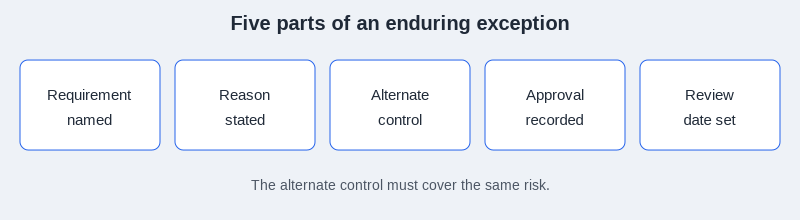
First, name the requirement and quote its wording. Second, state the reason it cannot be met as written. Third, name the alternate control that covers the same risk. Fourth, name the approver and the approval date. Fifth, set a review date for the exception.
The alternate control is the heart of the record. It must reduce the same risk the requirement targets. A monitoring step does not replace an encryption requirement. A policy note does not replace a technical control. Match the strength of the alternate control to the risk.
Evidence the assessor will ask for
An assessor will examine the approval record. An assessor will interview the approver about the risk decision. An assessor will test the alternate control to see if it works. Prepare evidence for all three methods, not just one.
Keep the approval record with the requirement response. Do not bury it in a separate file the assessor never sees. Link the exception to the requirement in your evidence index. Note the review date in the same place.
Mistakes that turn an exception into a failed requirement
Do not use an exception to excuse a control you never built. Do not leave the approver blank. Do not set a review date and then ignore it. Do not copy one exception across many requirements. Each requirement needs its own reason and its own alternate control.
Review each exception at least once a year. Check that the reason still holds. Check that the alternate control still works. Retire the exception when the standard wording fits again. An exception that no one reviews stops being credible.
Sources
- NIST SP 800-171 Revision 2.
- NIST SP 800-171A.
- Original diagram by PolicyCortex.
Next step
Want evidence tied to each requirement from live systems? See how PolicyCortex collects it.