October 24, 2026
How Do I Document Controls Inherited From My Cloud Provider?
Your cloud provider runs part of your security, but your assessor still asks you for proof.
NIST means National Institute of Standards and Technology. CUI means Controlled Unclassified Information. SSP means System Security Plan. POA&M means Plan of Action and Milestones. CSP means cloud service provider.
What inherited means
An inherited control is one another party runs for you. Your provider may run the data center. Your provider may run the network. Your provider may run the host system. You still use the control. You do not run all of it.
NIST SP 800-171 Revision 2 requires you to describe how you meet each requirement. Requirement 3.12.4 sets the SSP rule. The SSP must describe the boundary and the environment. It must show how each requirement is met. That rule is in NIST SP 800-171 Revision 2.
Inherited does not mean ignored. It means split. Your SSP must show the split clearly. An assessor must see who does what. A vague line that says the provider handles it will fail.
Split each control into three parts
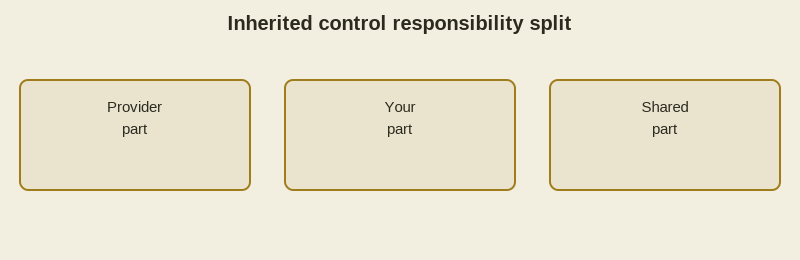
Use three parts for every inherited control. Provider part, your part, and shared part. Write each part in plain words.
The provider part is what the provider runs. Physical security of the data center is one example. Host patching is another example. Network firewall rules may be a third.
Your part is what you run. User access to your tenant is your part. Data classification is your part. Incident response for your data is your part.
The shared part is what you both run. Logging is often shared. The provider collects the logs. You review them. Backup is often shared too. The provider stores the backup. You test the restore.
Gather the provider evidence
Ask your provider for three items per control. The service description that names the control. The audit report that covers the control. The responsibility matrix that splits the control.
Keep the newest version of each item. Note the date and the scope. If the report covers only part of the year, note that gap. If the report covers only some services, note that limit.
Do not paste a full provider report into your SSP. Summarize the relevant part in two sentences. Cite the report name and date. File the full report behind the SSP.
Write the SSP line for each control
Use one line per control in the SSP. Start with the requirement number. State the split in one sentence. Name your evidence in the next sentence.
A strong line reads like this. Requirement 3.1.1 limits system access to authorized users. The provider controls data center entry. We control tenant user access. Our evidence is the dated access review.
A weak line reads like this. Access is handled by the provider. That line hides your part. It hides the evidence. It invites a finding.
Prove your part with your own records
Provider evidence proves the provider part. It does not prove your part. Collect your own records for your part.
Access reviews prove your user access control. Log review sheets prove your log review. Restore tests prove your backup control. Training records prove your awareness control.
NIST SP 800-171A lists records among the artifacts assessors review. The guide lists policies, procedures, and plans too. That list is in NIST SP 800-171A Revision 2. Keep your records dated and named. A record without a date is a weak record.
Watch for gaps at the seam
Most inherited control failures happen at the seam. The seam is where provider work ends and your work starts. Log review is a common seam failure. Backup restore is another.
Check each seam twice a year. Ask who does the task. Ask what record proves it. Ask what happens when it fails. If no one owns the seam task, assign it now.
Update the SSP when the provider changes a service. Update it when you change a tool. Update it when a report scope changes. A stale split misleads the assessor and your own team.
Next step
PolicyCortex collects evidence from live Azure configuration with 33 collectors. The collectors read conditional access, diagnostic settings, Defender posture, backup, and firewall. The evidence is evaluated against NIST 800-53 and NIST 800-171. That evidence supports re-verification after remediation. SAR means Security Assessment Report. It generates SSP, SAR, and POA&M output from collected evidence. AWS means Amazon Web Services. PolicyCortex is strongest in commercial Azure, and AWS is covered. Start at policycortex.com.
Sources
- NIST SP 800-171 Revision 2, Protecting Controlled Unclassified Information in Nonfederal Systems and Organizations. https://doi.org/10.6028/NIST.SP.800-171r2
- NIST SP 800-171A Revision 2, Assessing Security Requirements for Controlled Unclassified Information. https://doi.org/10.6028/NIST.SP.800-171a
- NIST SP 800-53 Revision 5, Security and Privacy Controls for Information Systems and Organizations. https://csrc.nist.gov/pubs/sp/800/53/r5/upd1/final
- Diagram: original by blog.nist800171evidence.com.