November 03, 2026
How Do I Document Media Protection for Requirement 3.8.3?
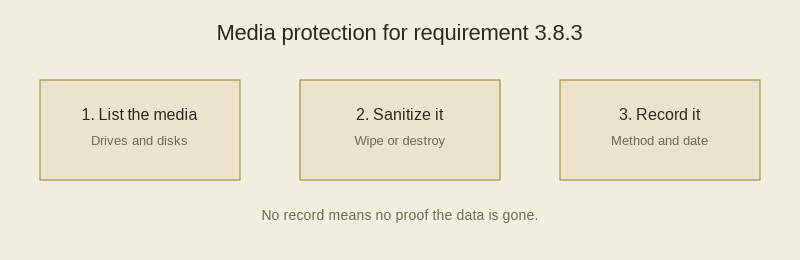
An old drive leaves your office, and no one can prove what was on it. That is the exact gap requirement 3.8.3 exists to close. The fix is a short record for every piece of media.
Controlled Unclassified Information (CUI) is government information that needs protection. NIST Special Publication 800-171 Revision 2 sets the rules for protecting it. Requirement 3.8.3 states the media rule in one line. Sanitize or destroy media holding CUI before disposal or release for reuse.
What counts as media
Media means any device that can store data. Hard drives and solid state drives count. USB sticks and backup tapes count. Old phones and tablets count too. Paper counts when it holds CUI in printed form. If it can carry CUI out the door, treat it as media.
List every piece of media that holds CUI. Give each item an ID, a type, and an owner. Record where it is stored. Update the list when media arrives or leaves. A list that misses old drives is a list an assessor will question.
Sanitize or destroy: pick the right method
Sanitize means clearing data so it cannot be recovered. Wiping a drive with an approved tool is one method. Degaussing magnetic media is another method. Destroy means physical ruin, such as shredding or crushing. The method must fit the media type. Wiping works for a drive you will reuse. Shredding fits a drive you will discard.
Record the method for each item. Record the tool or vendor used. Record the date and the person who did the work. For destroyed media, keep the vendor certificate of destruction. For wiped media, keep the wipe log that shows the result.
The record an assessor wants
Build one media disposal log. Give it these columns: item ID, media type, CUI type, method, date, person, and proof. Proof means the wipe log or the destruction certificate. File the proof with the log, not in a separate folder.
Assessors use NIST Special Publication 800-171A Revision 2 methods. They examine records, interview staff, and test controls. They may pick a disposed drive at random. They will ask for its record. They may ask staff to describe the disposal process. The log and the staff story must match.
Common gaps to close
The first gap is reuse without a record. A wiped drive returned to service needs a wipe log. Without it, the reuse looks unproven. The second gap is vendor disposal with no certificate. Ask the vendor for the certificate before the truck leaves. The third gap is paper. Shred bins need a pickup log too. A bin with no log is an unproven step.
What to do this week
List all media that left your office in the past year. Find the disposal record for each item. Close any item with no record by writing what you can still verify. Then set the rule: no media leaves without a log entry first.
Sources
- NIST SP 800-171 Revision 2, National Institute of Standards and Technology.
- NIST SP 800-171A Revision 2, National Institute of Standards and Technology.
- NIST SP 800-88 Revision 1, Guidelines for Media Sanitization, National Institute of Standards and Technology.
- Original diagram by PolicyCortex.
Next step
Want media evidence linked to each requirement? See how PolicyCortex collects it from live systems.