October 30, 2026
How Do I Scope the System Boundary So My CUI Evidence Stays In-Bounds?
Your evidence file keeps growing, but your assessor keeps asking what is in scope. The problem is rarely missing evidence. The problem is a fuzzy boundary. Fix the boundary first.
What a boundary is
NIST SP 800-171 Revision 2 requires you to define your system boundary. NIST is the National Institute of Standards and Technology. The guide protects CUI. CUI means Controlled Unclassified Information.
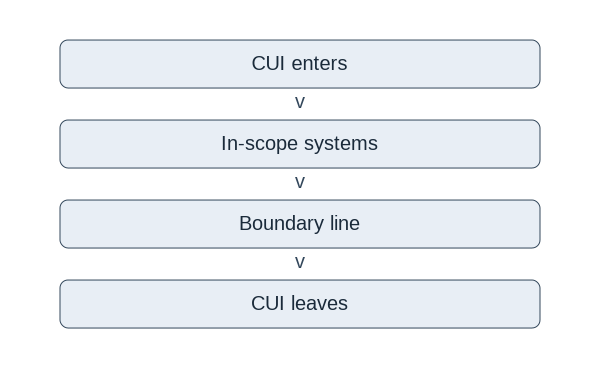
The boundary is the line around the systems that store, process, or transmit CUI. Everything inside the line is in scope for the 110 requirements. Everything outside the line is out of scope, unless CUI flows there too (NIST SP 800-171 Revision 2).
Requirement 3.12.1 requires the boundary and the operating environment to be described. Requirement 3.12.4 requires a System Security Plan. SSP means System Security Plan. The plan must describe how each requirement is met inside the boundary.
Start with the CUI flows
List every place CUI enters your company. That includes email, portals, file shares, and vendor systems. Then trace each flow to where it is stored. Then trace it to where it leaves.
Any system that touches the flow is inside the boundary. A print server that prints CUI is inside. A backup that holds CUI is inside. A laptop that opens CUI at home is inside.
This flow list is your boundary draft. If a system is not on any flow, it is likely out of scope. If a flow has no system listed, your boundary has a hole.
Draw it and name it
Draw a simple diagram. Show each in-scope system as a box. Show each CUI flow as a line between boxes. Show each connection to an outside system as a line that crosses the boundary edge.
Name the diagram with a date and a version. Keep it in the SSP. When a system changes, update the diagram first. Evidence filed against an old diagram will confuse the assessor.
Assessors use NIST SP 800-171A to test the boundary. That guide tells them to examine the system description and test the controls in it (NIST SP 800-171A).
Handle shared and cloud systems
Shared services need a clear split. Name what the provider runs and what you run. File the provider evidence for their part. File your evidence for your part. Do not file provider evidence as if it were yours.
Cloud systems need the same split. Your cloud tenant is inside the boundary if it holds CUI. The provider data center sits outside your control, but your settings inside it are yours. Evidence for your settings belongs in your file.
Remote laptops need a rule, not an exception. If a laptop can reach CUI, it is in scope. State that rule in the SSP. Then file evidence for those laptops like any other system.
Test the boundary before the assessor does
Walk one CUI record from entry to exit. At each step, ask if the system is on your diagram. If a step has no box, add it or stop the flow there.
Then walk your evidence file the other way. Each artifact should map to a box on the diagram. An artifact with no box is out of scope, or your diagram is missing a box. Either way, fix it now.
Keep the boundary tight but honest. A wide boundary means more evidence to keep current. A narrow boundary that hides a CUI flow will fail on inspection. Honest beats small every time.
Next step
PolicyCortex collects evidence from live Azure configuration using 33 collectors. The collectors read conditional access, diagnostic settings, Defender posture, backup, and firewall. The evidence is evaluated against NIST 800-53 and NIST 800-171. It supports re-verification after remediation. It generates SSP, SAR, and POA&M output from collected evidence. SAR means Security Assessment Report. POA&M means Plan of Action and Milestones. PolicyCortex is strongest in commercial Azure, and AWS is covered. Start at https://policycortex.com.
Sources
- NIST SP 800-171 Revision 2, Protecting Controlled Unclassified Information in Nonfederal Systems and Organizations, National Institute of Standards and Technology. https://doi.org/10.6028/NIST.SP.800-171r2
- NIST SP 800-171A Revision 2, Assessing Security Requirements for Controlled Unclassified Information, National Institute of Standards and Technology. https://nvlpubs.nist.gov/nistpubs/SpecialPublications/NIST.SP.800-171a.pdf