October 26, 2026
How Do I Prove FIPS-Validated Encryption for Requirement 3.13.11?
Your assessor asks for proof that your encryption is validated. A vendor page that says "FIPS compliant" will not pass. Validated means a specific module passed a specific test.
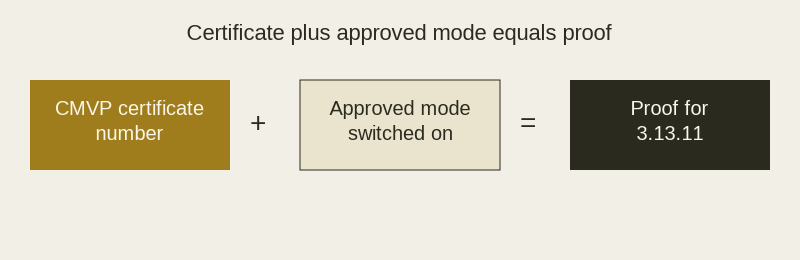
FIPS means Federal Information Processing Standards. NIST SP 800-171 requirement 3.13.11 says to use FIPS-validated cryptography when you protect the confidentiality of CUI. CUI means Controlled Unclassified Information. CMVP means Cryptographic Module Validation Program. CMVP is the NIST program that tests modules and issues certificates.
Step one: name the module
Find the exact module your product uses. A module is a piece of software or hardware that performs encryption. Get its name and version from the vendor. Then search the CMVP validated modules list for that name and version. Record the certificate number next to the module name. A certificate for a different version does not cover your version. A certificate for a similar product does not cover your product either.
Step two: prove approved mode is on
Validation alone is not enough. Most modules can run in approved mode or in non-approved mode. Approved mode means only approved algorithms run. Your system must run the module in approved mode when it protects CUI. Capture a config screen or a config file that shows approved mode is on. Date the capture. File it with the certificate. An undated screen proves little, since settings change.
Step three: map the module to the data
List each place where CUI is encrypted. For each place, name the module that protects it. Data at rest means data stored on disk. Data in transit means data moving over a network. Cover both. If one store uses a validated module and another does not, say so plainly. Fix the gap or record it in your Plan of Action and Milestones. POA&M means Plan of Action and Milestones.
What assessors check first
Assessors check three items. First, the certificate number matches the module and version in use. Second, approved mode is on where CUI is protected. Third, the evidence is current, not from an old install. A certificate for a retired version fails the check. A module running in non-approved mode fails the check too. Keep a one page table with module, version, certificate number, mode, and data covered. That table is the first thing the assessor should see.
Words that do not count as proof
"FIPS compliant" is a vendor claim, not a certificate. "FIPS ready" means the module is not yet validated. "Uses AES" proves an algorithm, not a validated module. AES means Advanced Encryption Standard. AES is approved, but approval of an algorithm is not validation of a module. Only a CMVP certificate proves validation. If your vendor cannot give a certificate number, the module is not validated. Plan a switch to a validated module and record the plan.
Sources
- NIST SP 800-171 Revision 2, requirement 3.13.11.
- CMVP Validated Modules list.
- FIPS 140-3, Security Requirements for Cryptographic Modules.
- Original diagram by PolicyCortex.
Next step
Want evidence tied to each requirement from live systems? See how PolicyCortex collects it.