October 31, 2026
Linux TCP Flaw Meets 800-171 Flaw Rules
National Institute of Standards and Technology (NIST) rules can sound abstract. A kernel flaw with two scores makes them concrete fast.
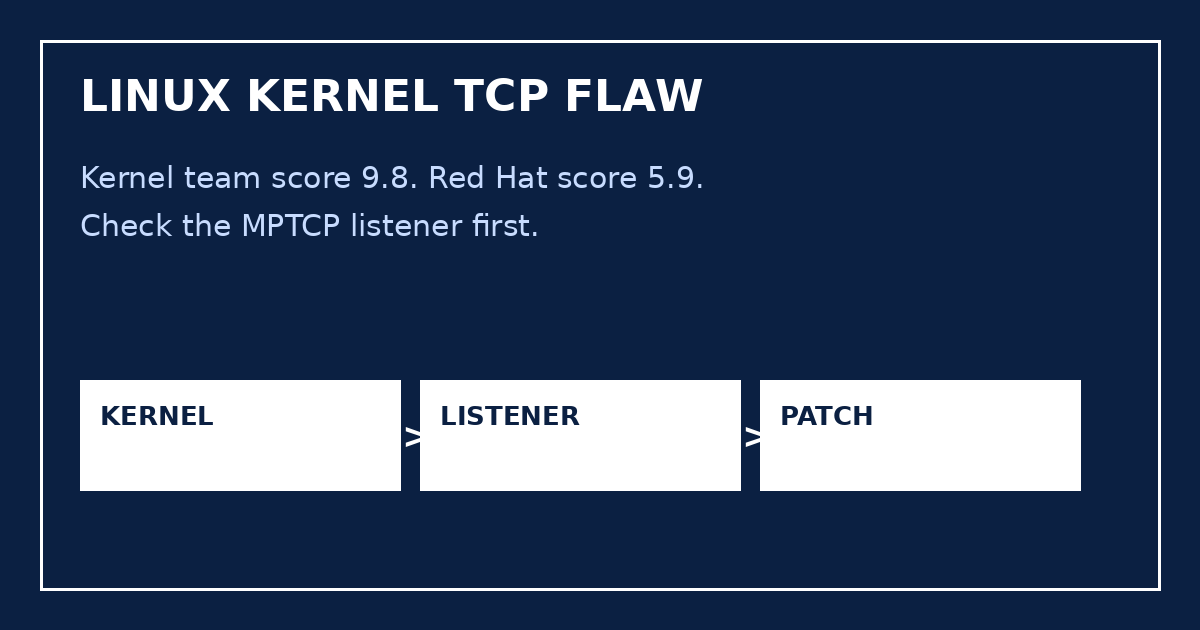
The record is CVE-2026-98432. Common Vulnerabilities and Exposures (CVE) is the record system. It is a use-after-free flaw in Linux kernel network code. The kernel team scored it 9.8 under Common Vulnerability Scoring System (CVSS) version 3.1. Red Hat rates it 5.9.
Requirement 3.14 in plain words
Requirement 3.14.1 covers flaw remediation directly. Identify, report, and correct flaws in time. A disputed score does not pause that duty. It changes the order of hosts, not the obligation.
Requirement 3.14.6 covers monitoring security alerts. Requirement 3.14.7 covers spotting unauthorized system use. Both apply while distributor fixes are still pending. Track Ubuntu and Red Hat Enterprise Linux hosts as open items.
Requirement 3.13 in plain words
Requirement 3.13.1 covers boundary protection directly. Monitor and control communications at external boundaries. A network flaw on a boundary host deserves first attention.
The public exploit needed a Multipath TCP (MPTCP) listener. MPTCP is Multipath TCP, a way to spread one connection over paths. Check boundary hosts for that listener first. Go 1.24 turns MPTCP on by default for Transmission Control Protocol (TCP) listeners on Linux. Some Go services may enable it without knowing.
What the record must show
Your record should name each host. It should state its kernel before the patch. It should state its kernel after the patch. It should state its listener result.
Upstream fixed versions include 6.1.190 and 6.12.113. Debian fixed Bookworm with 6.1.190-1. Debian fixed Trixie with 6.12.113-1. CIQ published nftables guidance as a bridge. It blocks Internet Protocol version 4 (IPv4) TCP packets with IP options. Disabling MPTCP alone is not enough.
No confirmed exploitation in the wild is reported. The flaw is not in the Known Exploited Vulnerabilities (KEV) Catalog. The Cybersecurity and Infrastructure Security Agency (CISA) maintains that catalog.
PolicyCortex does not patch Linux kernels. Vendors and distributors ship those fixes. PolicyCortex helps teams link proof to requirements.
What to do this week
List Linux hosts and their kernel versions. Check each host for an MPTCP listener. Patch where a fix exists. Track the rest as open flaws.
Sources
- CVE-2026-98432 record, CVE Program
- CVE-2026-98432 detail, National Vulnerability Database
- Anthropic Frontier Red Team exploit test, reported October 2026
- Red Hat rating of 5.9, reported October 2026
- CIQ nftables mitigation guidance, October 2026
- NIST Special Publication 800-171 Revision 2. https://doi.org/10.6028/NIST.SP.800-171r2
- Original diagram by PolicyCortex
Next step
Want 3.13 and 3.14 proof collected from live systems? See how PolicyCortex maps evidence to each requirement.