November 02, 2026
LXD Certificate Flaw: NIST 800-171 Authentication Evidence
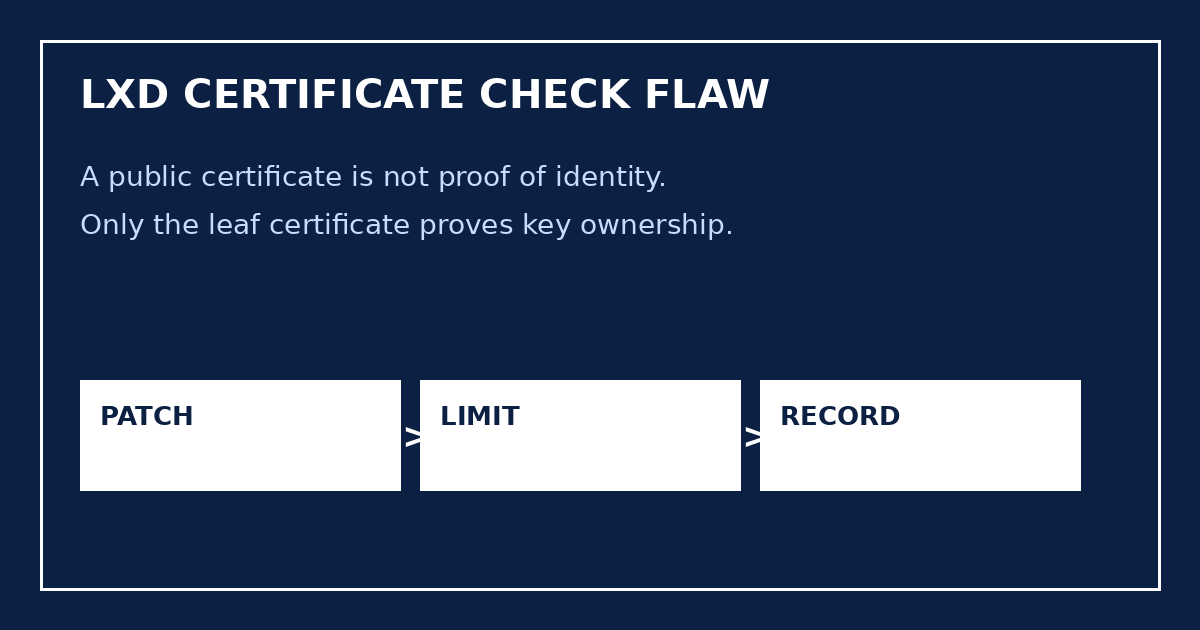
Identification and authentication must prove who acts. A flaw that accepts a borrowed public certificate proves nothing.
The flaw in plain words
Canonical published a security advisory on October 28, 2026. LXD manages containers and virtual machines. MicroCloud groups LXD hosts into a cluster. The record is CVE-2026-112816. The flaw is improper certificate validation. Mutual Transport Layer Security (TLS) should prove client identity. TLS is the protocol that secures the connection. The server compared every peer certificate to its trust store. Only the leaf certificate proves key ownership. An attacker can attach a trusted public certificate behind their own leaf. The server then accepts them as the trusted client. The score is 10.0 on the Common Vulnerability Scoring System (CVSS) 4.0 scale.
What the evidence must show
First, the inventory of hosts that run LXD or MicroCloud. Second, the installed release on each host. Third, the fixed release and the patch date for each host. LXD fixes are 4.0.15, 5.0.11, 5.21.9, and 6.10.1. MicroCloud fixes are 3.4.1 and 2.1.5. Fourth, proof the fixed release is actually running. Fifth, the trust store review for each host. Each entry grants identity to a holder. Record who approved each entry. Remove entries with no owner. Sixth, the listener exposure for each host. Limit access to trusted hosts until the patch lands.
What is not confirmed
No exploitation is confirmed for this flaw. It is not in the Known Exploited Vulnerabilities Catalog. Do not claim an attack in your evidence file. The control gap alone justifies the patch and the review.
PolicyCortex does not patch LXD hosts. PolicyCortex helps teams link proof to requirements.
Sources
- CVE-2026-112816 record, CVE Program
- Canonical security advisory, Critical vulnerability found in Canonical LXD and MicroCloud, October 28, 2026. https://discourse.ubuntu.com/t/security-advisory-critical-vulnerability-found-in-canonical-lxd-and-microcloud/90557
- Original diagram by PolicyCortex
Next step
Record the fixed release and the trust store review for each host.