October 22, 2026
What do assessors look at first in my evidence?
Your assessor visit is close and your evidence pile is huge. You want to know where they look first.
Short answer: they read your System Security Plan first. It is called the SSP for short.
Why the SSP comes first
The SSP is the document that describes your whole security setup. Requirement 3.12.4 says you must "develop, document, and periodically update" the plan (Federal Register).
The plan must "describe system boundaries" and "system environments of operation." It must also show how each rule is implemented and how your systems connect.
In plain words: the SSP says where your system ends, where CUI lives, and how each rule is met. CUI means Controlled Unclassified Information, which is government data that needs protection.
The SSP is the map. Without a map, the assessor cannot tell if your evidence covers the right systems. DoD's own rulemaking calls the SSP "a foundational document" for assessment (Federal Register).
The order an assessor follows
NIST SP 800-171A is the assessor's playbook. It defines three ways to check each requirement: Examine, Interview, and Test (SP 800-171A).
- Examine means reviewing documents: policies, settings, logs.
- Interview means talking with the people who run each control.
- Test means checking the control under real conditions.
Assessors apply these to each requirement's assessment objectives. An assessment objective is a "determine if" statement, for example "determine if access privileges are granted to separate individuals." Each objective gets a finding: satisfied or other than satisfied.
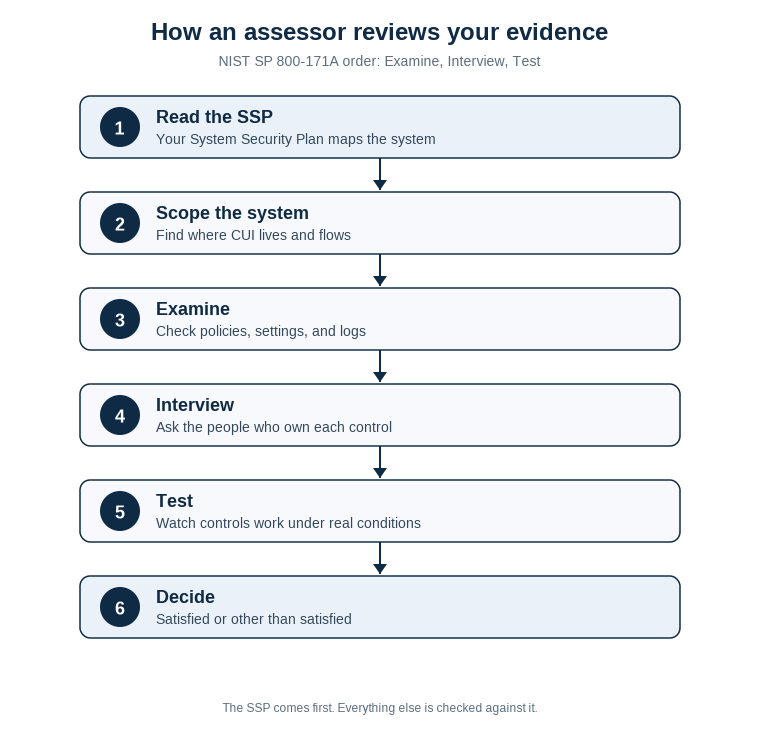
In practice the review runs in six steps, shown in the diagram above:
- Read the SSP. The assessor learns your boundary and where CUI flows.
- Scope the system. They check which systems actually touch CUI.
- Examine documents. They compare your policies and records to the objectives.
- Interview owners. They ask the named people what they do and why.
- Test controls. They watch the control work, not just the paper about it.
- Decide. Each objective becomes satisfied or other than satisfied.
What gets the deepest look
Some requirements, per DoD, "have more impact on the security of the network and its data than others" (methodology summary). The methodology is DoD's published standard for these assessments (DFARS 204.73).
Assessors spend the most time on the rules that protect CUI directly. That means access control, encryption, incident response, and system integrity.
In 800-171A, these requirements list all three methods, Examine, Interview, and Test, which signals a deep review. The lesson: front-load proof for access control, incident response, system integrity, and encryption. Those draw the hardest questions.
What makes them dig deeper, or move on
Assessors move on when three things line up: a policy, proof you follow it, and a recent date. They dig deeper when something is missing.
Signals that earn a quick pass:
- The SSP points at the exact file for each requirement.
- Logs and settings exports carry collection dates.
- Each control names one owner and one backup.
- Your own test records show the control worked on a date.
Signals that trigger a deeper dig:
- A policy with no proof it is followed.
- Screenshots with no dates and no system names.
- Evidence that only covers one of the three methods.
- Different answers from the SSP and the people interviewed.
Fix the second list before the visit, not during it.
How to front-load your package this week
- Put the SSP and its requirement index on top of the package. The index maps each requirement to its files.
- For each requirement, add one item per method: something to Examine, someone to Interview, something to Test.
- Refresh dates on logs and settings exports. Anything older than your review cycle looks stale.
- Rehearse the interviews. Each owner should explain their control in two sentences.
- Run your own spot tests and record the results with dates.
An assessor who finds the SSP clear and the index complete starts the review already trusting the package. SAR means Security Assessment Report. POA&M means Plan of Action and Milestones. PolicyCortex reads live Azure configuration and builds SSP, SAR, and POA&M output from the collected evidence. The top of your package stays current after every fix.
Sources
- NIST SP 800-171A Rev. 2, Assessing Security Requirements for CUI
- Federal Register, DFARS rule citing requirement 3.12.4 and the SSP's role
- DFARS Subpart 204.73, Safeguarding Covered Defense Information
Next step
Build the top of your package first: a clear SSP and a complete requirement index. See how PolicyCortex keeps Azure evidence fresh for assessors without manual exports.