October 31, 2026
What Evidence Satisfies Audit Requirement 3.3.2 for Reviewing and Analyzing Logs?
Your logs pile up every day, but your assessor wants proof that someone actually reads them. A log file alone proves collection, not review. You need records that show review happened, by whom, and what it found.
A numbering note first, because it changes the evidence
NIST SP 800-171 Revision 2 is the guide for this article. NIST means National Institute of Standards and Technology. In that guide, requirement 3.3.2 has one job. It requires that actions of single users can be traced to those users (NIST SP 800-171 Revision 2).
Log review itself sits in nearby requirements. Requirement 3.3.3 requires review and update of logged events. Requirement 3.3.5 requires correlation of review, analysis, and reporting for signs of unlawful or unusual activity. An assessor will check all three together, because review without traceability proves little.
So file evidence for the set, not for one number alone. Traceability makes review possible. Review makes the logs useful. Correlation turns single events into a case.
What proves traceability under 3.3.2
Start with unique accounts. Each person needs their own account. Shared accounts break traceability, because an event cannot be tied to one person. If a shared account must exist, log who holds its secret and when it is used.
Next, prove the log fields are complete. Each record should carry the user, the time, the source, and the action taken. A log with no user name fails the trace test. A log with no time stamp fails it too.
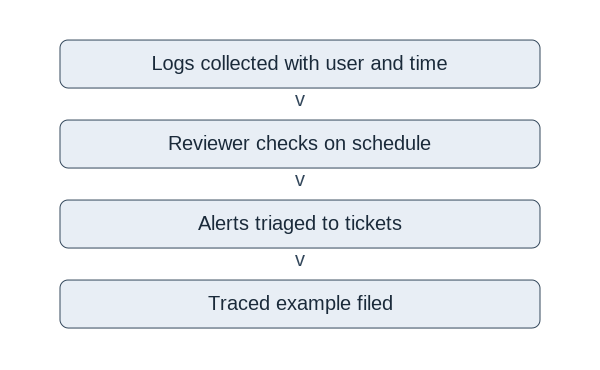
Keep a sample that an assessor can follow. Pick one real event, such as a login or a file access. Show the log line, then show the person it maps to. That worked example beats a policy page that claims traceability exists.
What proves review under 3.3.3 and 3.3.5
Keep a dated review record. Each record names the reviewer, the date, the log sources checked, and the result. A record that says "reviewed" with no date proves nothing. A record with a date, a name, and a result proves review happened.
Automated alerts count as review support, not as review alone. Keep the alert, the triage note, and the outcome together. An alert with no follow up looks like noise, not review. An alert with a closed ticket shows a full loop.
Review on a set schedule, and write that schedule down. Daily checks suit high risk events, such as failed logins and privilege changes. Weekly checks suit broader log sources. Monthly checks suit trends and gaps. The schedule must match what your records actually show.
What to file for the assessor
File five items in one folder. First, your log review procedure, with roles and schedule. Second, your list of log sources inside the system boundary. Third, dated review records for the last several months. Fourth, alert and ticket records that show follow up. Fifth, one traced example that links a log event to a single user.
Name each file with a date and a topic. A folder of files named "final" and "final2" will slow any review. A folder sorted by date tells the assessor where to start.
Protect the logs themselves. Limit who can change or delete them. Keep them where only named reviewers can edit them. A log that anyone can rewrite proves nothing, no matter how neat it looks.
Next step
PolicyCortex collects evidence from live Azure configuration using 33 collectors. The collectors read conditional access, diagnostic settings, Defender posture, backup, and firewall. The evidence is evaluated against NIST 800-53 and NIST 800-171. It supports re-verification after remediation. It generates SSP, SAR, and POA&M output from collected evidence. SAR means Security Assessment Report. SSP means System Security Plan. POA&M means Plan of Action and Milestones. PolicyCortex is strongest in commercial Azure, and AWS is covered. Start at https://policycortex.com.
Sources
- NIST SP 800-171 Revision 2, Protecting Controlled Unclassified Information in Nonfederal Systems and Organizations, National Institute of Standards and Technology. https://doi.org/10.6028/NIST.SP.800-171r2
- NIST SP 800-171A Revision 2, Assessing Security Requirements for Controlled Unclassified Information, National Institute of Standards and Technology. https://nvlpubs.nist.gov/nistpubs/SpecialPublications/NIST.SP.800-171a.pdf