November 04, 2026
What Evidence Satisfies Risk Assessment Requirement 3.11.2?
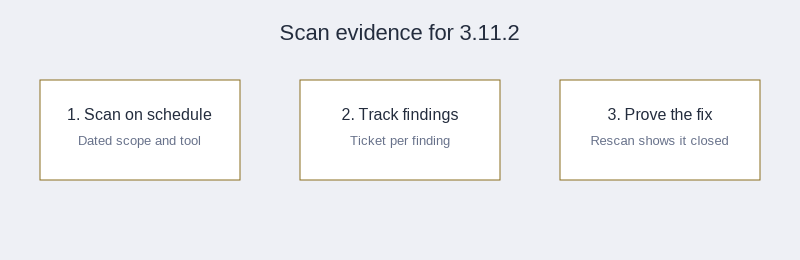
Your scan tool runs every week, but the assessor still asks for more proof. Scans alone do not pass the requirement. The fix is to file the scan, the findings, and the fixes as one chain.
NIST Special Publication 800-171 Revision 2 sets safeguards for Controlled Unclassified Information (CUI). CUI is sensitive government information that needs protection, but is not classified. Requirement 3.11.2 sits in the risk assessment family. It asks you to scan for weak points on a set schedule. It also asks you to scan when new weak points are found.
What the requirement asks for
Read the requirement as two duties. First, scan on a schedule you wrote down. Second, scan again when a new weak point is announced. A schedule with no scans proves nothing. Scans with no schedule prove no habit.
Write the schedule into your plan. State how often each system type is scanned. State who runs the scans and who reviews them. State what counts as a new weak point that triggers an extra scan.
The scan record an assessor wants
Each scan needs a record with five facts. The date of the scan. The scope, meaning which systems were scanned. The tool used, with its version. The findings list, with a severity for each finding. The reviewer name and review date.
Save the full scan report, not just a summary page. A summary hides scope gaps. If a system was left out, the report should say why. If a scan failed part way, the record should say that too.
Keep scans in date order, in one folder. An assessor should move from the oldest scan to the newest without hunting. A gap in dates needs a note that explains it.
The findings chain that closes the loop
A finding is not closed by a ticket alone. Each finding needs a ticket, a fix, and a rescan. The ticket names the owner and the due date. The fix record names what changed. The rescan shows the finding is gone.
Set due dates by severity in your plan. Fix the most severe findings first. If a fix must wait, record the reason and the interim step. An interim step may be a blocked port or a limited account. It does not close the finding, but it shows control while you wait.
NIST Special Publication 800-171A Revision 2 sets how assessors check this requirement. They examine scan records, interview staff, and test controls. Staff must describe the same schedule the records show. A mismatch between words and records is a finding.
What to do this week
Write your scan schedule into your plan. File the last three scan reports with full scope. Check that every severe finding has a ticket, a fix, and a rescan. Close any chain that stops at a ticket.
Sources
- NIST SP 800-171 Revision 2, National Institute of Standards and Technology.
- NIST SP 800-171A Revision 2, National Institute of Standards and Technology.
- Original diagram by PolicyCortex.
Next step
Want scan evidence tied to each requirement? See how PolicyCortex collects it from live systems.