November 02, 2026
What Evidence Satisfies System and Communications Protection Requirement 3.13.1?
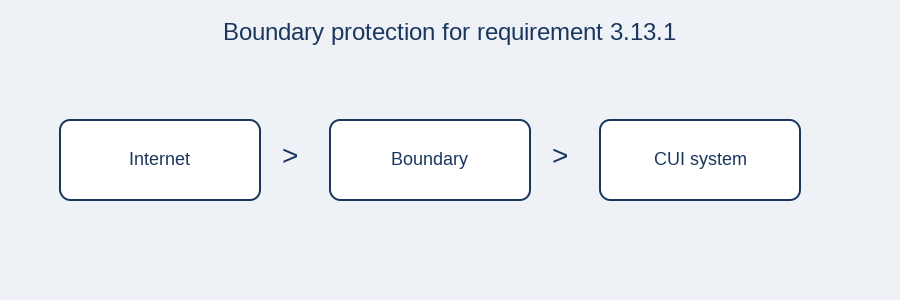
Your network has many doors. An assessor wants proof you watch each one. That proof is the heart of requirement 3.13.1.
NIST Special Publication 800-171 Revision 2 sets the requirement. It says to monitor, control, and protect communications at external boundaries. It also says to do the same at key internal boundaries.
What the requirement covers
An external boundary is where your system meets another network. The internet edge is the clearest case. A vendor connection is another case.
A key internal boundary separates parts of your own system. The line between office systems and Controlled Unclassified Information (CUI) systems counts. CUI is information the government marks as needing protection.
Monitoring means you watch traffic at those lines. Control means you allow only approved traffic through. Protection means you block the rest and record the attempt.
The evidence pack
Start with a current network diagram. The diagram must show every boundary point. It must show each firewall and each remote access point.
Next, add the firewall rule list for each boundary device. Each rule should show its purpose and its owner. A rule with no owner is a rule no one defends.
Then add monitoring records. Save log reviews for a sample period. Show who reviewed the logs and what they found. Show the ticket for each finding that needed action.
Add remote access records too. List each approved remote access method. Show the access logs for a sample week. An unlisted method is a boundary you do not control.
How assessors check it
Assessors use methods from NIST Special Publication 800-171A. They examine your diagram and your rule lists. They interview the staff who run the boundary devices. They test a sample of controls in action.
Expect a test of a blocked path. They may ask what happens to traffic from an unapproved source. Your logs should show the block and the alert.
Expect questions about change. They will ask how a new boundary device gets approved. Show the change record for your most recent addition. A clean change record proves the process works.
Common gaps to fix first
The most common gap is a stale diagram. A device added last year may still be missing. Walk your diagram against your real inventory this month.
The next gap is an unreviewed log pile. Logs no one reads prove nothing. A short review note with a date proves more.
The third gap is a forgotten vendor link. Old test links often stay open after a project ends. List every external link and its business owner. Close links with no owner.
What to do this week
Pick one boundary device and trace its evidence. Check its diagram entry, its rules, and its logs. Fix any part of that trace that is missing.
Sources
- NIST SP 800-171 Revision 2, National Institute of Standards and Technology.
- NIST SP 800-171A Revision 2, National Institute of Standards and Technology.
- Original diagram by PolicyCortex.
Next step
Want boundary evidence linked to each requirement? See how PolicyCortex collects it from live systems.